Mobility Innovation in Rural and Small Urban Communities: Data Analysis from Interactive Workshop
By Shared-Use Mobility Center
Apr 24, 2026
Background
On March 4, 2026, the Shared-Use Mobility Center (SUMC) hosted an interactive workshop during a session at the Northwest Pennsylvania Mobility Alliance’s Transit Retreat in Mobile, AL, exploring the challenges, knowledge gaps, and wishes that rural and small urban mobility providers have for their services.
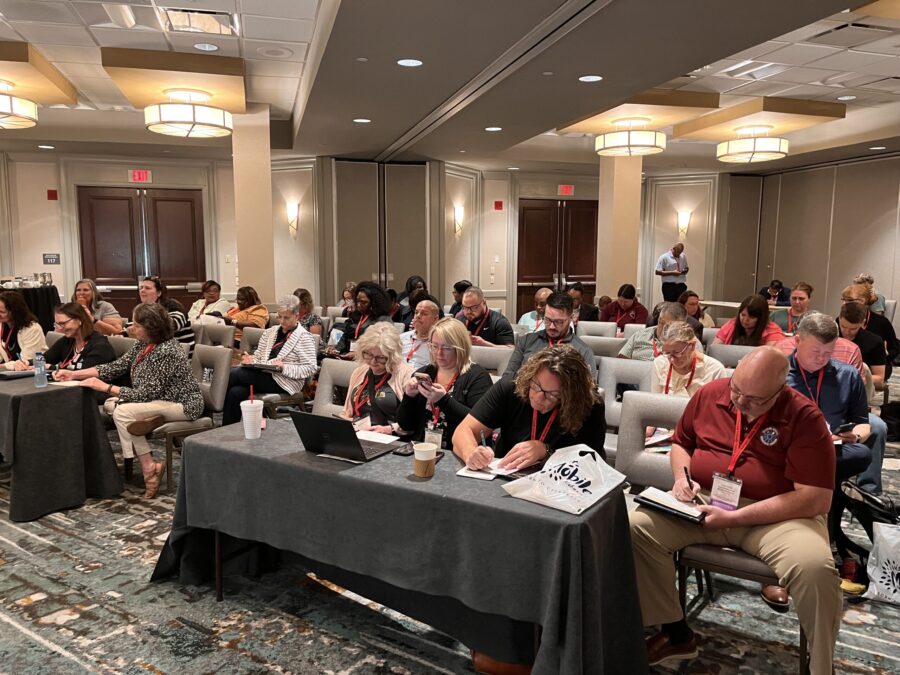
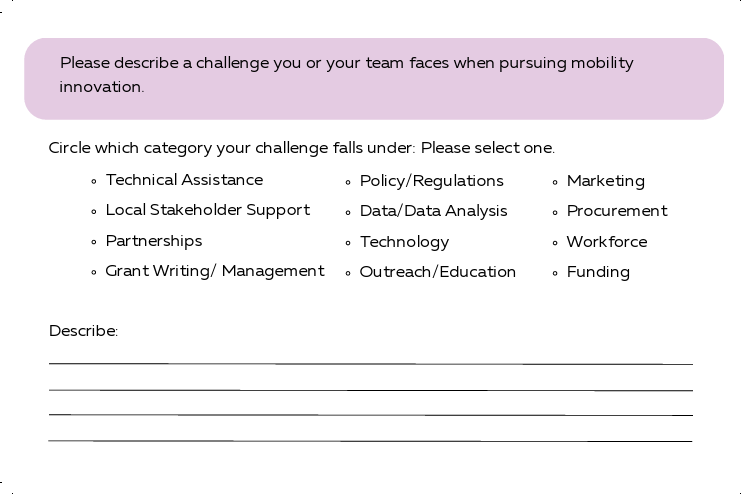
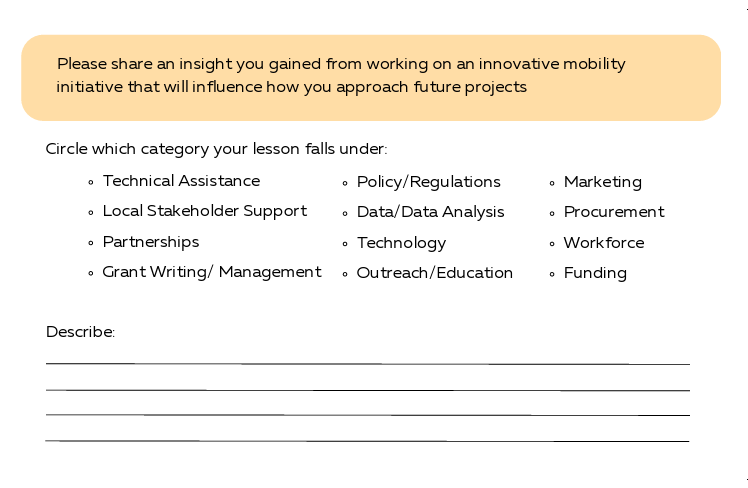
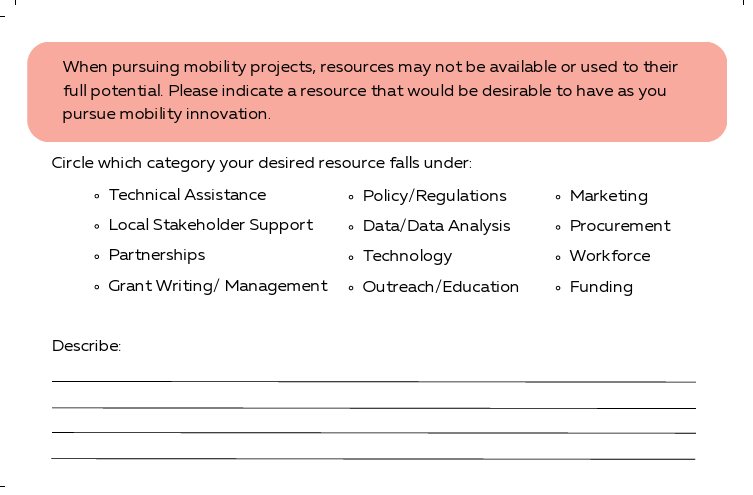
During the workshop, participants were given one of three cards at random: WISH, CHALLENGE, and LEARN. Each card had a prompt that aimed to tap into key practitioner insights in pursuing innovative mobility projects. Copies of these cards are available in the Appendix. After filling out their cards, each participant paired with a partner to share and discuss what they wrote. After the initial 1-1 discussion, attendees exchanged cards with their partners and moved into small group discussions based on their new cards, where they relayed their partners’ thoughts to drive the conversation. Throughout the course of the workshop, SUMC took notes on key insights from the discussions and collected the cards afterwards as a way of recording data on the major drivers, motivations, goals, and barriers for rural and small urban practitioners in pursuing innovative projects.
SUMC collected about 40 cards with participants’ responses and after the Retreat analyzed them. Instead of manually transcribing participants’ handwritten cards, SUMC used an AI tool (ChatGPT) to identify, aggregate, and present in a readable format scans of the participants’ insights, which SUMC reviewed and checked for accuracy. SUMC then analyzed this information and summarized the findings. Below is a summary of this analysis.
Executive Summary
Responses suggest that many issues with innovative mobility projects revolve around institutional capacity rather than technology. Agencies are not just looking for new tools, but structures, partnerships, and support systems that help them implement innovation effectively. The most common needs and themes throughout the cards included:
- Strong stakeholder engagement and institutional buy-in
- Clear partnerships
- Technical assistance and capacity building
- Reliable data collection and evaluation processes
- Flexible institutional processes
- Sustainable funding strategies
CHALLENGE
The CHALLENGE card responses suggest that the largest barriers to mobility innovation in rural and small urban settings may be wider institutional and resource constraints, rather than technology itself. Major takeaways from the CHALLENGE cards included:
Funding
The most prominent theme for the CHALLENGE cards (and a theme that appeared on other cards, as well) surrounded funding constraints and challenges in accessing grant funding. Several responses referenced difficulties securing funding, including comments about grants becoming more competitive and resources being limited. As mentioned specifically by one card: “with grants getting harder to receive due to increased interest, funding projects has become more difficult.”
Other responses noted challenges in identifying grant opportunities and more general lack of available funding for specific types of projects.
These insights suggest that programs that provide stable funding pathways, implementation grants, or financing models would address a major barrier to implementing innovative projects.
Organizational Capacity and Workforce Limitations
Some responses referenced staff capacity and organizational ability to manage projects, noting that even when opportunities exist, teams may lack the time or expertise to pursue them fully. As one respondent wrote, “not enough workforce to fill the gaps or start new pilots.”
Innovative projects might fit outside of traditional agency skill sets, and when pursuing new pilot projects, agency staff may need to take on a variety of responsibilities in addition to their day-to-day roles. This insight may also support the need for more technical assistance programs.
Coordination and Partnerships
A number of cards circled the partnerships and local stakeholder support categories, indicating that collaboration challenges are common. One respondent wrote that developing partnerships has become a “redundant challenge,” implying a longstanding and ongoing issue. These challenges may be exacerbated in more rural areas, as noted by one participant.
Innovative mobility projects often require coordination between agencies, cities, private mobility providers, community organizations, and others. Misaligned priorities or unclear roles can pose major barriers to progress.
Procurement and Institutional Barriers
Some cards indicated challenges related to procurement, policy, or internal processes. Traditional procurement systems may not always be well-suited for innovative pilot projects or emerging technologies, and agencies may face slow contracting timelines or rigid rules. One participant mentioned that “policy and regulations create road blocks to use resources that are already in place.” Procurement resources and tools focused on innovative mobility pilots may help accelerate experimentation.
Data and Evaluation
A few responses referenced data or data analysis. Per responses, agencies may struggle to collect reliable data from pilots, evaluate outcomes, or share data across partners. Without strong data, it becomes difficult to justify scaling projects. There is therefore a need for shared metrics, evaluation frameworks, and data standards for innovative mobility projects.
WISH
Several common themes emerged from the WISH cards:
Technical Assistance
Some participants noted the desire for more hands-on guidance to help move innovative ideas into implementation. This includes support with planning, designing pilot projects, and navigating institutional processes. This implies that agencies may have ideas for mobility innovation but lack specialized expertise to execute them, and emphasizes the value of tailored programs that provide technical assistance providers, toolkits, or other forms of project support.
Stakeholder Support
Building community and partner buy-in emerged as a theme in multiple cards. As one respondent mentioned: “we have an opportunity for local leadership to prioritize innovative ideas and new solutions rather than ‘we’ve always done it that way’ and unwillingness to invest.” Strategies and tools to engage in partners and build community and political buy-in for innovative projects would be key resources for agencies.
Implementation Support
Several responses wished for support to address specific technical assistance initiatives, resources for procurement guidance, and grant support can help agencies turn innovative ideas into real projects. Many of these revolved around funding and grant writing support, but other cards noted a wish for more robust training programs, marketing strategies, or support for outreach and rider education.
Knowledge, Capacity Building, and Workforce Development
Some responses noted tools and resources that would be helpful to strengthen internal capacity when implementing innovative projects. These included resources for training and workforce development (multiple responses noted a lack of workers and drivers in rural agencies) and data analysis. One card response circled Data/Data Analysis as a category and asked questions about what trends and opportunities are occurring and what the future of innovation might look like, suggesting that robust tools to measure impacts and inform projects could help move the industry forward.
LEARN
Some of the most impactful lessons learned and important factors leading to successful projects from the LEARN cards included:
Partnerships and Stakeholder Engagement
Many cards emphasized local stakeholder support, outreach, or partnerships, noting that projects are more successful when stakeholders are involved early and continuously.
One respondent gave a personal account showing the importance of strong collaboration: “I worked with a local trail group/economic development/tourism agency to implement a bikeshare program in a rural county. It took all involved to make it a success.” On the other hand, one respondent highlighted some issues that can arise with a lack of clear expectations: “as I worked on a project with the healthcare and human services entities, I found that they did not plan for the mobility aspect of the project.”
Ultimately, mobility innovation should prioritize strong relationship-building and stakeholder engagement from the very beginning of the project, and ensure that all partners align on goals and expectations.
Robust Community Engagement
Some cards expressed lessons learned about community outreach and engagement. One participant in particular expressed surprise at learning how many people in a rural community were not aware of the transit agency’s existence at all. While responses did not note any specific strategies for robust community engagement, they do highlight the importance of education, outreach, and connection for innovative projects.
The Relationship Between Data and Funding
Several responses referenced data or data analysis. Agencies have learned that collecting and analyzing data early in a project is essential, and multiple participants recognized the relationship between good data collection and funding to support scaling pilots. As one respondent noted about this relationship: “I’ve learned how closely related funding and data are. Agencies rely on real-time accurate data and in turn, it determines the funding/budgeting that [the] agency receives. I’ve learned to really emphasize the importance of accurate reporting/data since this is something agencies focus on heavily.”
As many demonstration projects start with grant funding but may struggle with long-term sustainability, data collection and analysis can be a valuable tool to gather stakeholder buy-in.
DREAM
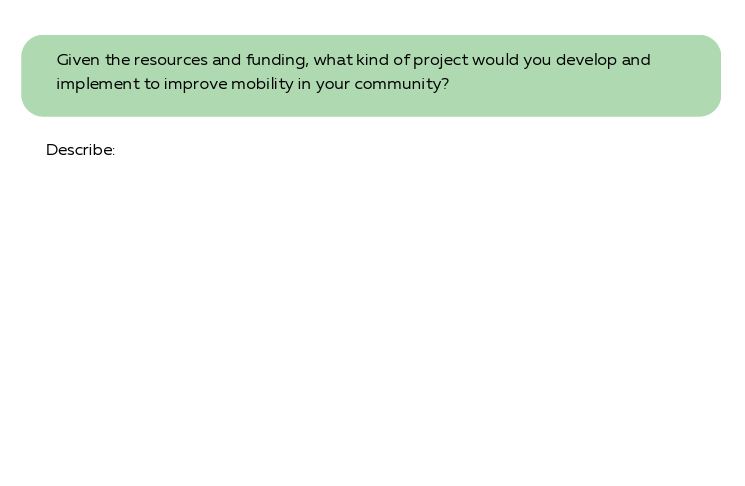
Finally, participants were encouraged to fill out an additional card, DREAM, to share what projects or initiatives they would pursue given unlimited resources. While there were significantly fewer filled out DREAM cards, the common theme showed a vision for transportation to be welcoming, exciting, and inspiring. As one respondent wrote:
“Think European transit systems: Bus stops, tram spots, and rail everywhere. Buses are clean with work stations and wifi, and the stops are welcoming environments. When developing new projects, I think we should keep this vision front of mind so that the newest projects that look like this vision inspire the next generation of projects to look even better.”
Workshop Cards
The content and conclusions of this document are solely those of SUMC.